November 19, 2025
Event announcement: INTERCULTURALITY UNDER THREAT: An Analysis of Repression and the Constitutional Reform Plans in Ecuador
Interculturality as a key concept of coexistence based on indigenous relational territoriality is a cornerstone of Ecuadors’ constitution. The Carta Magna from 2008 recognises nature as a legal subject, enshrines the Sumak Kawsay (Buen Vivir, The Good Life) as a guiding principle in 99 articles and guarantees ample collective rights including bilingual intercultural education. This ground-breaking legal framework figures among the most comprehensive in the world. Our guests trace the origins of this notion of interculturality back to the streets and to the demands of indigenous and popular movements of the 1990s while also reflecting on current events. In October, in the face of rising commodity prices, government plans to open new oil camps in the Ronda Suroriente and the Ronda Subandina as well as to extend mining in indigenous territories, protesters took to the streets again. The government led by Daniel Noboa has answered with severe repression leading to arbitrary detentions and even the killings of three indigenous persons. The president’s plans of a constitutional reform and the socio-political climate in the country have sparked an urgent question:
Is Ecuador’s interculturality under threat?
Anita Krainer, phD, specialized in sociolinguistics. Since 2008, professor in the master’s program for socio-ecological studies at FLACSO Ecuador, head of the research group “Laboratorio de Interculturalidad” and the postgraduate program “Interculturality and Development.” Long-standing university professor and researcher in intercultural topics; project management of international cooperation projects in Latin America; teaching at renowned universities in Europe and Latin America (FLACSO-Ecuador, UASB-Bolivia, University of Vienna, Karl-Franzens University Graz, FAU-Erlangen). Main research interests: Intercultural education, indigenous peoples, knowledge dialogue, diversity, sustainable development, conflict management in multi-ethnic contexts, as well as qualitative, participatory, and decolonial research methods.
Johannes M. Waldmüller is an associate researcher at the IDR at Boku, Vienna, the Global Studies Institute at the University of Geneva, and head of the Academy for the Common Good for the Cooperative for the Common Good. Johannes holds a PhD f rom the IHEID in Geneva, was a postdoctoral researcher at NYU in New York, and between 2016 and 2021 held a professorship in international environmental policy at the Universidad de Las Américas (UDLA) in Quito, Ecuador, as well as visiting professorships at Flacso Ecuador and Argentina, and the Universities of Vienna (2021-2022 and 2023-24) and Toulouse (2019-2020). His research focuses on issues of human rights and the rights of nature, SDGs, and disaster prevention in intercultural understanding.
C.IAS Spotlight Talks – The C.IAS spotlight talks are a monthly format that aims at shedding light on pressing sociocultural topics in the Americas.
Find out more here:
October 2, 2025
Event announcement: Days of Indigenous Resistance 2025
In 2024, the Center for Inter-American Studies (CIAS) provided significant support for the Days of Indigenous Resistance organized by the Indigenous Rights Collective. The extensive Indigenous Resistance Day conference, which featured a mix of lectures, concerts, and workshops, reached a target audience of more than 100 people. To continue this success, Indigenous Resistance Day will be organized at the CIAS premises on October 9, 2025, from 1:00 p.m. to 9:00 p.m.
The focus will be on indigenous peoples’ views on colonization and globalization, as well as the protection of cultural heritage as an essential component of biodiversity and an indispensable building block of a sustainable society. Researchers and activists will offer practical approaches to indigenous knowledge in masterclasses on Andean methods of music composition, language, and relationship networks in Moche culture. Finally, a book presentation on the Hopi indigenous people will bridge the gap to US ancestral peoples, thus optimally covering the CIAS’s sphere of influence. Further opportunities for networking and exchange will be provided by film presentations from the Amazonian film school, followed by discussions. The event offers students and colleagues a range of topics that are rarely addressed in the Central European university context, while also highlighting concrete opportunities for action in the Global North that combine social engagement and research.
Find out more here: https://inrico.at/tdiw25/
September 26, 2025
In the Name of Nida: Institutionalizing Evangelical Thought through Translation Studies
This paper critically revisits the symbolic recognition of Eugene Nida in translation studies in the light of his involvement in missionary organisations and missionary translator training. We examine how the reception of Eugene Nida within translation studies has contributed to legitimizing evangelical missionary activities throughout history and nowadays. Our analysis first illustrates various modes of Nida’s representation in translation studies and draws links to the Summer Institute of Linguistics. Subsequently, we outline how Nida’s active engagement in missionary organizations played a critical role in establishing their academic legitimacy. Finally, we embed these insights in a broader discussion of the relationship between translation studies and missionary translation. Our findings show the need for thorough scholarly debate aimed at reassessing the positioning of key figures within the disciplinary canon and reconstructing the effects of 20th and 21st century missionary translation on the rights of Indigenous peoples, their cosmovisions and their territories.
Read the full article here:
July 28, 2025
Bárbara Muelas: First indigenous women to be appointed to the Academia Colombiana de la Lengua
To honour her dedication to linguistics and her important work on, among many other things, the translation of the Colombian constitution into Namtrik, Bárbara Muelas, an indigenous woman from the Misak community of Colombia, was appointed to join the Academia Colombiana de la Lengua. Her acceptance speech explores the often tense relationship between her people’s cosmovision and the institutional framework of the Colombian state it often has to fit into. Muelas also reflects on the importance of language and how it is fundamentally tied to how people understand the world around them.
Drawing on her expertise in languages and the translation process, Muelas highlights how different the perception and relation of time and space is in her culture compared to the western world that is represented by the Spanish language.
[…] Para nuestro pueblo, el tiempo y el espacio no son entidades separadas o lineales; por el contrario, son realidades profundamente entretejidas. El tiempo no es una línea recta que avanza hacia adelante; más bien, es una corriente viva que nos rodea continuamente.
Muelas finds that in the cosmovision shaped by the Namik language not only is the perception of time and space more fluent and dynamic, but so is their perspective on the territory. In her experience, there is a deep connection between language and territory, and the two cannot be thought as separately. Forests, rivers, lakes, and mountains are not viewed as passive objects but as active participants in the formation of meaning and they carry ancestral meaning.
At various points in her speech does Muelas highlight translation as not merely a process of linguistic equivalence, but as a negotiation between cosmovisions – a perspective that is particularly interesting for Translation Studies. She reflects on this process in her speech by sharing one of her memories from translating the Colombian constitution into Namtrik in 1992. Translating western concepts like “State” into the indigenous language posed a challenge, since the concept does not exist in their cosmovision. Finally, the team decided to use the term “Nu pirau” which means “greater territory”, reinterpreting the concept through a territorial and relational lens rather than a stiff centralised one. While this translation skilfully represents a western concept through an indigenous perspective, it also risks reinforcing western hierarchies by positioning the nation-state above indigenous territories through the use of the word “greater”. This idea can undermine indigenous claims to autonomy by linguistically legitimising a vertical political structure in which indigenous territories are seen as “lesser” or subordinate. Although the term can be criticised, it should be highlighted that the team was highly aware of the complexities of the translation process:
Cada palabra traducida fue un proceso de profunda reflexión y consenso comunitario.
Finally, a look at this discourse in front of a generally western institution poses the question whether Bárbara Muelas’ experiences and work could be used to inspire greater political discussions about indigenous rights in relation to their territories and cosmovisions.
Read the entire speech here: https://cambiocolombia.com/cultura/el-namtrik-y-el-espanol-tiempos-paralelos-territorios-linguisticos-en-dialogo-el-hermoso
January 24, 2025
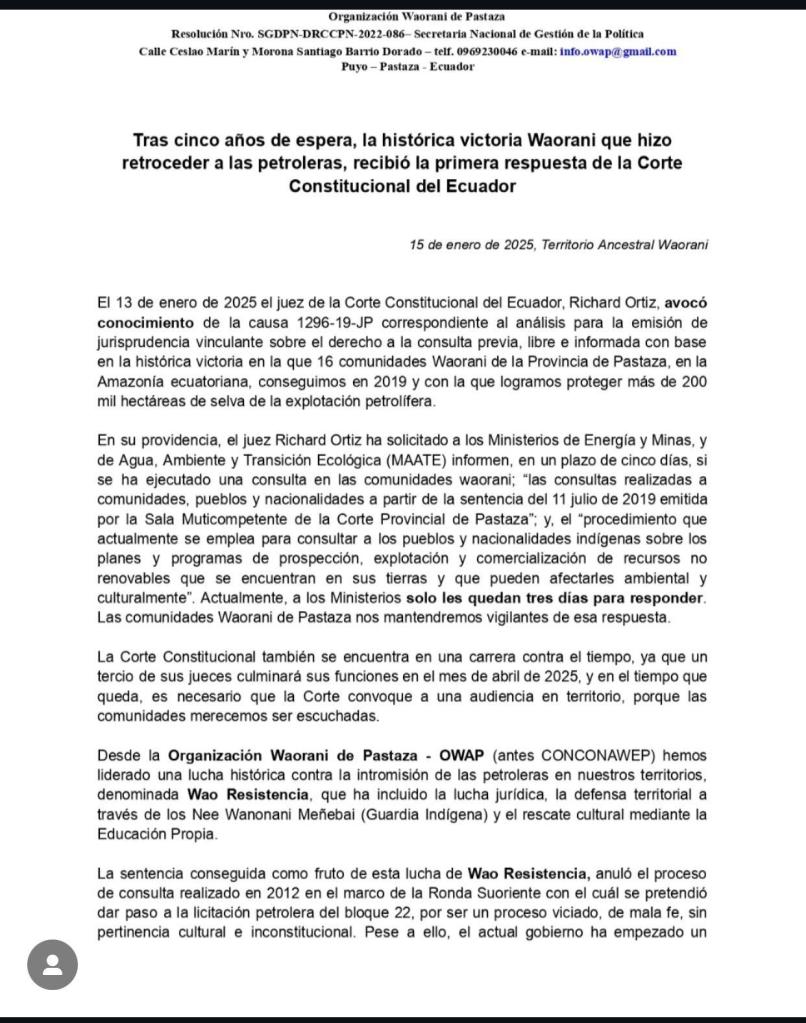
Resistance against oil companies through Jaguar-Man figure Meñebai
In a recently published communiqué the organisation of the Waorani people in the province of Pastaza (OWAP) provided a follow-up to a landmark case they had won in 2019 in the Pastaza Provincial court. The allegations against the Ecuadorian government offering land for oil drilling without proper free, prior and informed consultation had been ruled in favor of the Waorani people. Oil projects affecting 16 comunidades (village communities) on more than 200 million hectares of their land were stopped and precedent for informed consent and indigenous participation was set. However, until now no such consultations have taken place which is why the OWAP communiqué reminded the ministeries in charge of their duty. They also described the Waorani people’s on-going resistance against oil companies operating in their territory. Resistance, according to OWAP, is based on three pillars: legal fights, territorial defense through the Nee Waonani Meñebai as indigenous guards and promotion of culture through their own education. The Meñebai is a figure envisioned as half-jaguar and half-man which is also found on signposts in the territory. The communiqué shows the jaguar as an important element of Waorani cosmovision and reminds us of thinking defiance as a transculturation process.
Header image by Miguel del Cuadro/ instagram: @miguel_delcuadro
„The idea behind the mural proposes the integration of shadows through recognition, which is known as the process of individuation according to Carl Jung. These are the inner demons that we keep inside and that grow larger from childhood if they are not recognized. That is why the snake and the jaguar look playful with their big eyes, representing that childishness.
The image has Amazonian influence because I love jaguars and snakes, and my paternal family is from the jungle.“
 Translating Cosmovisions